Aluminum Tile Trim Sourcing Guide: The Hidden Cost of Tile Trim Procurement
Leave a message
As building material wholesalers, distributors, or project procurement managers, our daily job is to maximize supply chain efficiency under the premise of ensuring quality. However, in the procurement of aluminum decorative profiles (such as tile trims and flooring transition strips), you have likely faced this exact dilemma
A Real Case Scenario:
A construction project required a batch of specific aluminum L-shaped and square tile trims. The procurement manager sent the exact same CAD technical drawing and samples to multiple suppliers:
- Supplier A offered a highly attractive total: $10,000 USD
- Supplier B offered a more conservative total: $12,000 USD

Facing identical-looking products, the instinctive reaction is often: "Since the drawing specifications are identical, I will choose the cheaper option and save $2,000 USD for the company."
1. Where Is the Missing $2,000 USD Hidden?
Why can Supplier A offer an ultra-low price of $10,000 while Supplier B insists on $12,000? Is it simply because Supplier B wants a higher profit margin? Deep laboratory testing reveals that the secret lies in a core industry hidden rule within the extrusion process: "Inconsistent thickness across different faces."
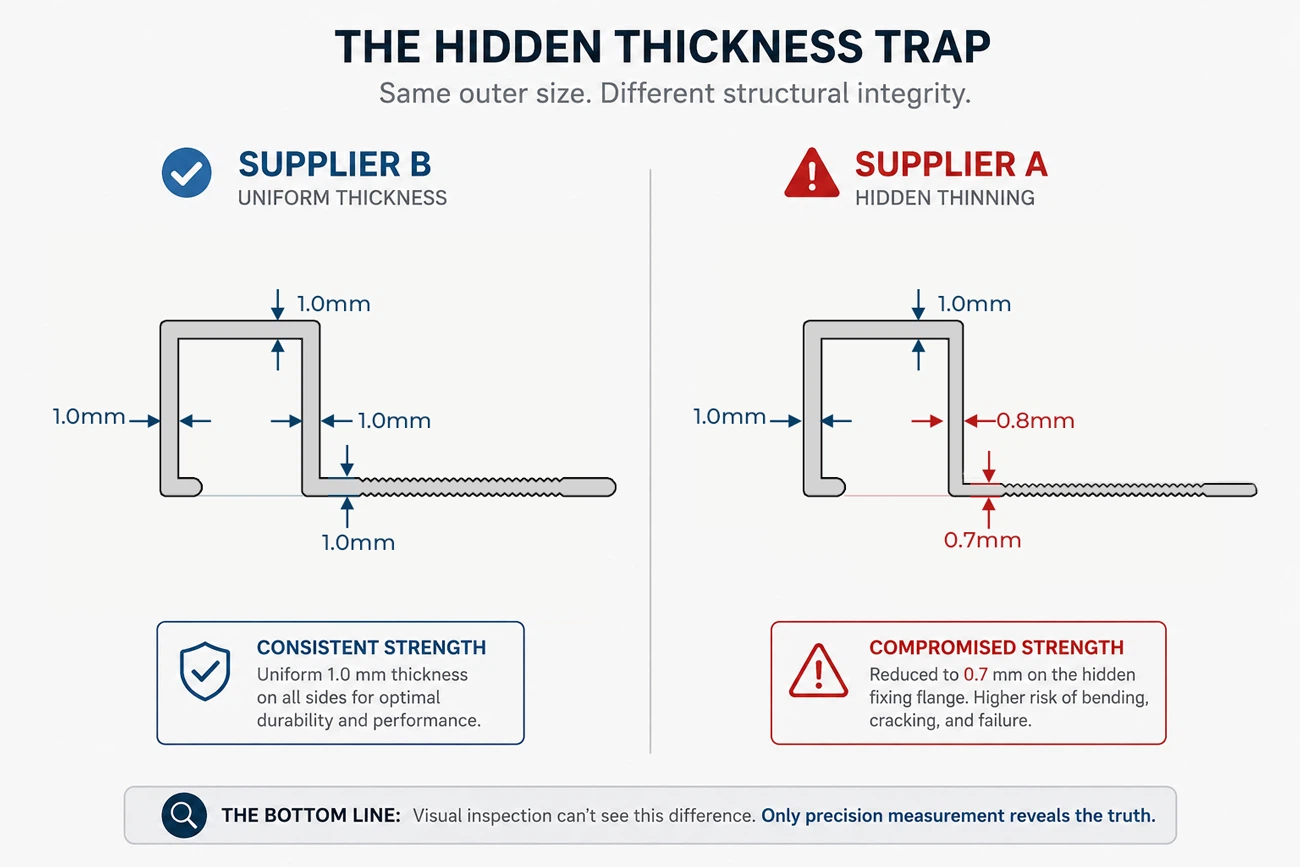
A standard tile trim consists of multiple cross-sections: the visible decorative face, the hidden fixing flange under the tile, and internal support angles. To win on price, Supplier A manipulated the extrusion mold by targeting the blind spots that customers rarely measure:
- Supplier A (Quoting by Sample): They kept the visible decorative face at the requested 1.0mm. However, they secretly reduced the hidden fixing flange and internal support structures to 0.8mm or even 0.7mm. This slashes physical strength, uses less material, drops the weight per meter, and artificially lowers the price.
- Supplier B (Quoting by Drawing): Whether it is the exposed face or the flange buried in cement, every single measured point features a consistent, uniform thickness of 1.0mm. Their $12,000 quote reflects actual aluminum weight and architectural-grade product lifespan.
2. What Happens After Choosing the $10,000 Cheap Quote?
In the follow-up of this case, the procurement manager chose Supplier A's $10,000 low-price option. However, once the goods arrived on-site and large-scale installation began, severe issues emerged:
- Plummeting Installation Efficiency: Workers discovered the profiles were highly prone to slight twisting (Twist) during cutting. On walls exceeding 2.4 meters, the lines could not align properly, forcing constant work stoppages to correct deviations and delaying the project schedule.
- On-Site Cracking and Sagging: Tile adhesive exerts continuous lateral pressure through thermal expansion and contraction during curing and daily use. Within three months of completion, trims in high-traffic areas collapsed and deformed under the impact of handcarts and suitcases.
- Exorbitant Rework Costs: Tile trims are permanently sealed within tiles and cement. Replacing deformed profiles meant smashing expensive surrounding marble and tiles, clearing the joints, and repasting everything. The secondary rework material and labor costs far exceeded the initial $2,000 USD saved.
3. Why Do "Drawing Quotes" and "Sample Quotes" Deviate?
This discrepancy happens because the aluminum profile industry prices products completely based on "Weight per Meter" . Total weight dictates the cost, and the actual thickness of each face dictates the weight.
- Quoting by CAD Drawing: Manufacturers calculate the weight per meter based on the "idealized, uniform thickness on all sides" theoretical dimensions marked on the technical drawing, yielding a standard theoretical price.
- Quoting by Physical Sample: When a manufacturer receives a physical sample, engineering measures the actual thickness of every face. If that sample was already thinned out by a previous supplier ("thick front, thin back"), its actual weight per meter will be significantly lower than the drawing.
* If a client provides a CAD drawing along with the explicit required weight per meter, supplier pricing will not deviate significantly.
4. Hero Metal: Aligning with Premium Standards via "Uniform Thickness"
As a mid-to-high-end architectural-grade profile manufacturer, Hero Metal possesses the technology to produce various wall thicknesses, but we always prioritize structural stability and safety over cutting corners. We refuse to join bottomless price wars by invisibly reducing material thickness.


Whether for export trade or large-scale engineering projects, our products guarantee uniform thickness across all faces, exceptional linear straightness, and are entirely free of surface extrusion die lines (Die Line Free). Engineered to match the strict mechanical standards of 6063-T5 primary aluminum, our profiles fully comply with EU CE certification and Middle East SASO certification.
5. Three Steps to Identify Product Quality and Suppliers
When facing uneven market quotes, protect your procurement funds through this three-step quality audit:
| Audit Step | Inspection Operation | Underlying Business Logic |
|---|---|---|
| 1. Micrometer Multi-point Measurement | Cut open a sample piece and use a micrometer to measure the visible decorative face, fixed bottom flange, and internal corners. | Directly exposes whether the supplier has utilized "hidden thickness reduction" tricks on hidden faces. |
| 2. Theoretical Weight Verification | Weigh a full-length profile, calculate its actual weight per meter, and check it against the original CAD drawing. | Ensures the supplier has not cut corners on the overall density of the aluminum and total material weight. |
| 3. Primary Aluminum Grade Sheet | Require the supplier to provide official quality inspection reports (e.g., SGS/TUV) for 6063-T5 primary aluminum. | Filters out low-cost recycled scrap aluminum that is highly prone to construction warping and twisting due to internal impurities. |
Choose Precision Engineering, Reject Costly Rework
In the building materials supply chain, a lower upfront quote on the surface often just means you are buying less aluminum. In high-end hotels, international airports, and large commercial projects, tile trims represent the final finish quality of the architecture. Choosing a long-term partner like Hero Metal that guarantees uniform thickness and honest quotes is the more vision-forward, genuinely economical choice.
We do not cut thickness, and we never cut quality.
Would you like an honest, precise cost and weight-per-meter evaluation?
Send your CAD drawings or physical samples to the Hero Metal Technical Engineering Department today for a transparent, mathematically rigorous factory-direct quote. Contact the Hero Metal Gold Team for a Premium Sample Box